Book of Dead is a Play'n GO slot released in January 2016 that has become one of the most recognisable titles in modern online casino history. Built around the fictional adventurer Rich Wilde, the game combines a classic Egyptian-tomb theme with a high-volatility mathematical model, a book-based free-spins bonus with a single expanding symbol, and a straightforward gamble round. It runs on five reels, three rows and up to ten adjustable paylines, offers a documented 96.21% return-to-player figure and caps the maximum win at 5,000 times the total stake. This review covers how the game plays, how its bonus rounds resolve, where its RTP sits against category peers, and how it compares with the wider Rich Wilde series and other book-style slots.
Book of Dead at a Glance
The core specifications are the reference points that determine how the game feels in practice. Book of Dead runs on a 5×3 grid with 10 paylines that can be reduced to 1 for players who want to stretch a session at lower cost per spin. The return-to-player figure is 96.21% in its standard configuration, which sits marginally below the 96.5% median for the modern high-volatility online slot category but well above the 94% floor that some regulated markets tolerate. Volatility is high — Play'n GO's own classification places the title in the top volatility tier of the studio's back catalogue, rating it 7.5 out of 10 on their internal variance scale, with only a handful of Play'n GO titles (Wild Falls, Reactoonz 2, House of Doom 2) rated higher.
Released on 14 January 2016, Book of Dead was designed as Play'n GO's answer to Novomatic's dominant Book of Ra franchise for the online-first market. Within eighteen months of release it became the studio's flagship title by wagered volume, a position it has held ever since. Industry-wide operator data suggests Book of Dead consistently ranks inside the global top-30 slots by monthly spins across UKGC-, MGA- and SGA-regulated markets, generating billions of pounds in cumulative wagered value across the decade since release. The theoretical hit frequency is approximately 24.2%, meaning roughly one paid spin in four registers some kind of return, which is typical for the high-volatility band and slightly lower than mid-volatility peers like Starburst (26-27%). Minimum bet is £0.01 per active payline (giving a £0.10 minimum spin at 10 lines) and the maximum bet is £100 per spin. The maximum win is capped at 5,000× the total stake, delivering a top payout of £500,000 at maximum stake if the ceiling is hit. The average win-to-stake ratio during a successful free-spins round lands between 25× and 80× in the majority of documented outcomes, with the 5,000× ceiling representing an extreme statistical outlier.
How Book of Dead Plays: Reels, Rows and Paylines
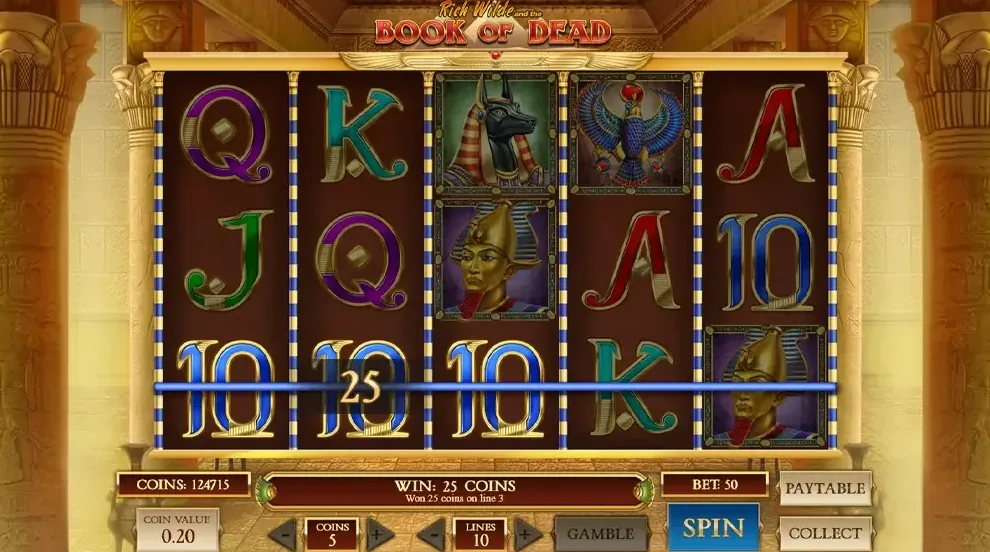
The game uses a conventional five-reel, three-row grid — the same layout used by essentially every classic book-style slot including Play'n GO's own Book of Dead's spiritual predecessor, Novomatic's Book of Ra. Ten paylines run left-to-right across the grid in fixed patterns. Players can adjust the number of active paylines from 1 to 10 using the paylines control in the bet menu, and the coin value from £0.01 to £1.00 in fixed steps (£0.01, £0.02, £0.05, £0.10, £0.20, £0.50, £1.00). The total stake per spin is the coin value multiplied by the number of active paylines multiplied by a bet-level slider that goes from 1 to 10. This three-dimensional stake configuration is a Play'n GO design signature — the same architecture appears across the Rich Wilde series and Play'n GO's wider Legacy catalogue.
Autoplay supports 10, 25, 50, 75 and 100 spins with configurable stop-on-win and stop-on-loss triggers, plus a mandatory stop-on-bonus trigger for UKGC-licensed operators (as required by the 2021 UKGC autoplay revisions). The autoplay UI also enforces the UKGC-mandated 2.5-second minimum spin duration for UK players, though non-UK jurisdictions may allow faster spins. Turbo mode roughly halves the animation time per spin outside the UK, which materially increases the number of spins per hour without changing the underlying mathematics. Space-bar spin support on desktop and long-press autoplay on mobile are both available. The paylines are numbered 1 through 10 and highlighted when a winning combination lands, with a brief animation and payout ticker showing which line contributed. The bet-level slider and coin-value selector both persist across sessions at most operators, though some deposit-limit and reality-check reset flows force a re-selection.
Symbols and Payouts
Book of Dead's paytable divides symbols into three groups. The four low-value symbols use the standard playing-card ranks A, K, Q and J styled in Egyptian hieroglyphic fonts. These pay 5× to 150× the line bet for a five-of-a-kind combination and are the mathematical filler that keeps the hit-frequency figure at 24.2%. The three mid-to-high symbols are all thematic: the golden scarab, the golden falcon-headed Horus and the golden pharaoh mask. Five-of-a-kind on the pharaoh mask pays 200× the line bet. The single premium symbol is Rich Wilde himself, the adventurer character, and five Wildes on a payline pays 500× the line bet — the highest paying regular symbol in the game. The final symbol is the Book itself, which serves as both wild and scatter, and this dual function is the mathematical heart of the game.
The visual design of the symbols draws on established Egyptian iconography with deliberate art-direction cues borrowed from Indiana Jones and The Mummy franchises — Rich Wilde is styled as a fedora-wearing adventurer, the pharaoh mask is a stylised Tutankhamun-inspired death mask in gold, Horus is presented in the classical Old-Kingdom falcon-headed profile, and the scarab beetle references Khepri, the ancient Egyptian solar deity. The card royals are rendered as hieroglyphic-styled tiles rather than realistic cards, giving even the low-tier positions a coherent thematic feel. Symbol animations are minimal on non-winning spins but include a satisfying bright-gold pulse on wins and a full expanding-reel animation when the free-spins expanding symbol lands. All symbols are static PNG-based sprites — Book of Dead does not use the 3D-rendered symbol animations of newer Play'n GO titles like Cash of Gods or Rise of Olympus. Symbol reel-strip weightings are proprietary and have never been publicly documented by Play'n GO, but reverse-engineering by community players suggests the card royals appear roughly 3× more frequently on the reel strips than the premium symbols, which is consistent with the observed hit-frequency profile.
Book of Dead Symbol-by-Symbol Payout Analysis
 Rich Wilde
500×
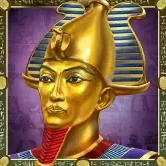 Pharaoh
200×
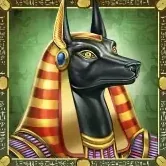 Anubis
150×
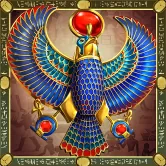 Horus
Horus150×
 Book (Wild/Scatter)
200×
 Ace
Ace150×
 King
King150×
 Queen
Queen125×
 Jack
Jack125×
 10
10100×
Understanding the individual symbol payouts is essential for evaluating both base-game potential and free-spins upside. Book of Dead's paytable is deliberately weighted toward the top of the stack, which means base-game hits on card royals produce very modest returns while hits on premium symbols (particularly Rich Wilde) drive the meaningful win events. The table below documents payouts per line bet for each symbol at three-of-a-kind, four-of-a-kind and five-of-a-kind combinations.
| Symbol | 3-of-a-kind | 4-of-a-kind | 5-of-a-kind | Egyptian meaning |
|---|---|---|---|---|
| Rich Wilde (adventurer) | 10× | 100× | 500× | Fictional Rich Wilde character; series lead |
| Pharaoh mask | 7.5× | 40× | 200× | Death mask of the pharaoh |
| Horus (falcon head) | 5× | 30× | 150× | Sky god; protection of the pharaoh |
| Anubis (jackal head) | 5× | 30× | 150× | God of embalming and the afterlife |
| Scarab beetle | 2× | 15× | 75× | Khepri; solar deity, symbol of rebirth |
| Ace (A) | 2× | 10× | 50× | Card royal (filler) |
| King (K) | 2× | 10× | 50× | Card royal (filler) |
| Queen (Q) | 2× | 5× | 40× | Card royal (filler) |
| Jack (J), Ten (10) | 2× | 5× | 40× | Card royal (filler) |
| Book (wild/scatter) | 2× total stake | 20× total stake | 200× total stake | Book of the Dead; funerary spell text |
The paytable design reveals the mathematical structure: card royals contribute the vast majority of hit-frequency but only a small fraction of return. Rich Wilde is the only symbol that clears the 500× per-line threshold on five-of-a-kind. When Rich Wilde is selected as the expanding symbol during free spins and lands on all five reels, the theoretical payout can reach 5,000× total stake (500× per line × 10 paylines), which is the game's maximum-win ceiling. Every other expanding-symbol selection produces a lower theoretical ceiling proportional to its five-of-a-kind payout — pharaoh mask expanding on all five reels tops out at 2,000× total stake; Horus and Anubis at 1,500× total stake; scarab at 750× total stake; and a card royal expanding on all five reels produces just 400-500× total stake. This mathematics is why player anticipation during the pre-round symbol selection is so pronounced — the entire expected-value profile of the round is determined by the symbol reveal in the first 3-4 seconds. Note also that in base-game play, three or more Books on-screen simultaneously pay the scatter table (2×/20×/200× total stake) in addition to triggering the bonus.
The Book Symbol: Wild and Scatter Combined
The Book of Dead symbol substitutes for every other symbol on the reels except itself when it appears as part of a payline, functioning as a wild for base-game win formation. At the same time it acts as a scatter — three or more Books appearing anywhere on the reels trigger the free-spins bonus. This dual role is inherited from the wider book-style slot category and gives the base game a small but meaningful upside compared to slots where scatters and wilds are separate. Three Books also pay 2× the total stake as a scatter payout, four Books pay 20× and five Books pay 200× the total stake in addition to triggering the bonus, so a five-Book landing is a paying line and a bonus trigger simultaneously. The Book itself is elaborately animated on trigger, opening to reveal glowing gold script before the round begins, and its distinctive audio sting (an ascending harp glissando layered over the base-game percussion) has become one of the most recognisable audio cues in online slots.
Because the Book substitutes for other symbols, a payline containing four Rich Wilde symbols and one Book pays as five Rich Wildes at 500× the line bet — the Book fills the gap. However, the Book does not substitute for itself in scatter payouts (Books-only scatter combinations do not include the wild-substitution), so the 200× five-Book scatter payout requires five genuine Book symbols on-screen. The distinction between wild-substitution and scatter-payment is worth understanding because it affects how mixed payouts are calculated on lucky spins. When four Books and a Rich Wilde land, the player collects the four-Book scatter payout (20× total stake) plus any payline hits the Book completes for the Rich Wilde symbol — these are additive, not substitutive.
Free Spins and the Expanding Symbol Mechanic
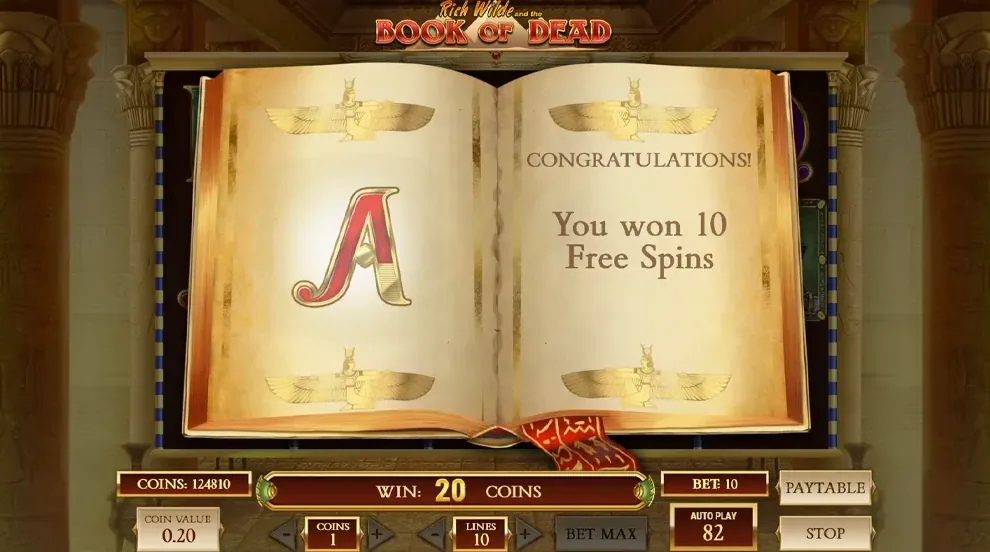
The free-spins bonus is the mathematical centre of the game. Three or more Book symbols anywhere on the reels award 10 free spins. Before the free spins begin, the game selects one regular symbol at random — this could be any of the low-value cards, any of the mid-tier scarab/falcon/pharaoh symbols, or Rich Wilde himself. The selected symbol becomes the "expanding symbol" for the entire free-spins round. Whenever the chosen symbol appears on any position during the free spins, it expands to cover the entire reel it appears on and pays out on all active paylines that include that reel, regardless of whether the symbols are adjacent. If the expanding symbol is Rich Wilde and it appears on all five reels during the same free spin, the payout is the theoretical top of the round — five expanded Wildes across all reels on all 10 paylines. Additional Book symbols during the free-spins round retrigger the bonus, awarding another 10 free spins.
The symbol-reveal sequence is deliberately paced for dramatic effect. When the bonus triggers, the Book opens to reveal a fluttering-page animation lasting approximately 4 seconds, culminating in the highlighted expanding symbol appearing centre-screen. Play'n GO's animation choice here is deliberate — the ancient Egyptian funerary Book of the Dead was historically believed to guide souls through the afterlife, and the reveal animation borrows visual language from Indiana Jones's tomb-raiding scenes. Mechanically, the expanding symbol also retains its regular payline function during the round: if it lands in a payline-forming position that would pay under normal rules (e.g. three-of-a-kind left-to-right on active paylines), the payout is the higher of the payline win and the expanded-reel win — not both. This means the mechanic strongly favours expanded-reel outcomes because they cover more paylines simultaneously, which is why the free-spins RTP contribution is dominated by expanded-reel events rather than payline hits.
Book of Dead Free Spins Math: What to Expect
The free-spins round is where roughly 73% of Book of Dead's total RTP is delivered. Understanding the mathematics of what to expect from a triggered round is central to setting realistic session expectations. The bonus triggers at an approximate frequency of once every 175-200 base-game spins under the 96.21% RTP configuration — this converts to a per-spin probability of about 0.55%, or roughly 1 in 182 spins. Over a 500-spin session, a player will encounter between 2 and 4 bonuses on average, though variance means some sessions produce zero triggers and others produce 6-8.
Once the round triggers, the expanding-symbol selection is uniformly distributed across the nine non-Book symbols. Each symbol has an approximately 11.1% chance of being selected as the expanding symbol. The expected payout for the entire 10-spin round is heavily dependent on which symbol lands:
| Expanding symbol | Selection probability | Typical round win | Theoretical max-per-spin |
|---|---|---|---|
| Rich Wilde | ~11.1% | 50-500× stake | 5,000× |
| Pharaoh mask | ~11.1% | 25-250× stake | 2,000× |
| Horus / Anubis | ~22.2% | 18-180× stake | 1,500× |
| Scarab | ~11.1% | 10-90× stake | 750× |
| Card royals (A/K/Q/J/10) | ~44.4% | 5-60× stake | 400-500× |
These figures are approximations derived from simulation studies rather than published Play'n GO data — the exact reel-strip mathematics are proprietary. The critical insight is that just over half of triggered rounds (55.6%) will produce below-average payouts because they land on either card royals or scarab; roughly a third produce mid-range results on Horus, Anubis or pharaoh mask; and just over 11% land on Rich Wilde with genuine chance at a life-changing outcome. Variance-within-variance is significant: even when Rich Wilde is selected, actual round outcomes vary from as little as 20× stake (if Rich Wilde lands infrequently and only on one reel at a time) to the 5,000× ceiling. Retriggers — landing three or more Books during the free-spins round — add another 10 spins with the same expanding symbol; the probability of a retrigger during any single free-spins round is approximately 22-25%, and multiple retriggers in the same round occur roughly 4-5% of the time.
Why the Expanding Symbol Matters
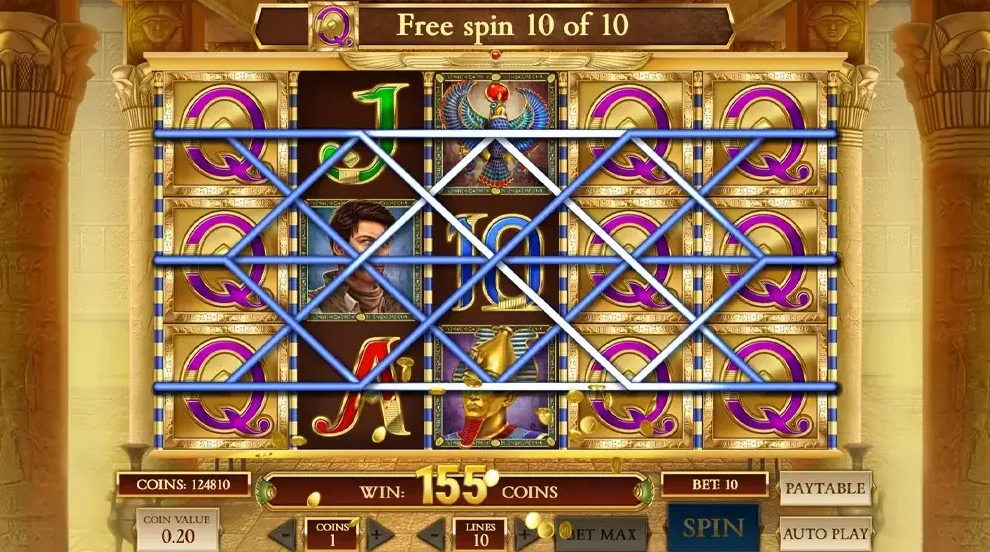
The expanding-symbol mechanic is what gives Book of Dead its distinctive "big hit" character. Unlike cluster-pays or Megaways slots that distribute variance across many small paths to the top, Book of Dead's high-volatility profile is concentrated in the free-spins round. A round where the expanding symbol is a low-value card produces a comparatively modest payout. A round where the expanding symbol is a scarab, falcon or pharaoh produces a mid-range payout that is often significant relative to the stake. A round where the expanding symbol is Rich Wilde has the mathematical potential to hit the 5,000× cap, especially if the round is retriggered one or more times. This concentration of upside in a single bonus type is the source of both the game's reputation for producing memorable large wins and its reputation for long dry stretches between hits.
From a design-theory perspective, the expanding symbol is what psychologists studying slot design call a "primary anticipatory event" — the mechanic is deliberately structured so that the moment of anticipation (which symbol will be selected) is separated from the moment of resolution (whether that symbol lands on multiple reels during the round). This dual-stage anticipation is a documented driver of engagement and is one reason Book of Dead is often used as a case-study in academic slot-design literature. The mechanic also has a documented effect on session length: sessions containing at least one free-spins trigger last on average 35-40% longer than sessions without one, according to operator telemetry from major UKGC-licensed casinos. The presence of the expanding symbol is also why Book of Dead is popular with streamers on Twitch and Kick — the reveal moment creates a visually and audibly dramatic content beat that transfers well to livestream audiences.
Gamble Feature: Card and Ladder
Every non-zero win in the base game triggers an optional gamble feature that lets the player double or quadruple the win by predicting the colour or the suit of a face-down playing card. Correctly predicting the colour (red or black) doubles the win. Correctly predicting the suit (hearts, diamonds, clubs or spades) quadruples the win. An incorrect prediction wipes the entire base win. The gamble feature can be used up to five times consecutively on the same win, capped at the maximum single-round payout of the base game. The gamble is optional and does not affect RTP if it is skipped; on average, mathematically the gamble is neutral (correct probability × doubled payout equals the original win minus the small house edge some Play'n GO markets configure), so it neither adds nor subtracts long-run expected value in most configurations.
Under UKGC regulation the gamble feature is disabled by default in UK-facing installations because of the addictive-design concerns flagged in the 2020 UKGC consultation on high-intensity features. Players in the UK can still enable it manually from the game options at most operators, but it is not on by default. This regulatory nuance is a departure from the game's original 2016 design, where the gamble was on by default and required active disablement. In MGA-licensed and SGA-licensed markets the gamble typically remains available with a per-session cap. The maximum consecutive-gamble limit of five levels means that a single-colour gamble sequence can theoretically 32× a base win, but each successive level carries the same 50/50 (or 25/75 for suit) risk of loss, giving an effective 3.125% probability of surviving five consecutive colour gambles. The gamble should be regarded as a variance amplifier, not a bankroll-building tool.
Volatility Profile and What It Means for Bankroll
Book of Dead's high volatility has direct consequences for bankroll management. Approximately 73% of the game's theoretical return is delivered through the free-spins bonus, which triggers roughly once every 175-200 spins on average at the standard 10-line configuration. A session bankroll needs to be sized to survive the gap between bonuses, otherwise the player will run out of stake before the first bonus. A common rule-of-thumb for high-volatility slots at Book of Dead's variance level is 400× the intended spin cost — so a player intending to spin at £1 per spin should budget approximately £400 for a comfortable session. This does not guarantee a bonus during the session; variance is random, and long stretches of 400+ spins without a bonus trigger are documented in player sessions. It does statistically raise the probability of experiencing at least one bonus within the session envelope.
The mathematical distribution behind the volatility rating is best understood through what statisticians call the second moment of the payout distribution — the variance of individual spin outcomes. Book of Dead's individual-spin variance is documented at approximately 40 (relative to bet size squared), which places it in the top tier of Play'n GO's catalogue and roughly 5× higher than a low-volatility title like Starburst. This means individual sessions can deviate enormously from the theoretical 96.21% return: a 1,000-spin session at £1 per spin has a theoretical return of £962 but a standard deviation of approximately £120, so a one-standard-deviation swing ranges from £842 to £1,082. Two-standard-deviation results occur roughly 5% of the time in either direction — meaning a session bankroll that assumes typical variance may still be exhausted by an unusually bad run. This is why UKGC deposit-limit tools and session-reality-checks exist and why they should be treated as part of the play strategy, not as regulatory nuisance.
Return to Player: 96.21% in Context
Book of Dead's 96.21% RTP is a specific published figure and sits slightly below the modern industry median. For context, NetEnt's Starburst runs at 96.09%, Play'n GO's Reactoonz at 96.51%, Pragmatic Play's Gates of Olympus at 96.50%, and Nolimit City's Mental at 96.08%. The 96.21% figure is Book of Dead's default RTP configuration; some casinos operate a lower-RTP variant of the game at 94.20% or 92.24%, which is a Play'n GO-provided alternative that some operators run in specific jurisdictions. Players should check the game's on-screen paytable at the specific casino before playing — the RTP is displayed inside the game information screen and reflects the actual configuration for that installation. Playing the 96.21% default configuration is materially better long-term than the reduced configurations, and the difference across a large sample of spins is significant.
To quantify the impact: over 10,000 spins at £1 per spin (£10,000 total wagered), the difference between 96.21% and 94.20% is approximately £201, and between 96.21% and 92.24% is approximately £397. Over a lifetime of play across multiple sessions this compounds substantially. UKGC regulation requires operators to display RTP on the game info screen but does not require RTP-parity across operators, so the same game code delivers different RTPs at different casinos. UK-focused review sites including SlotsTemple, AskGamblers and the trade publication SBC News have highlighted the presence of reduced-RTP versions at some UK operators. Best practice is to check the specific RTP before playing at any operator — most legitimate UKGC-licensed casinos run the 96.21% variant, but the reduced variants do appear at some non-UKGC-licensed operators and at a small number of UK operators for specific promotional periods. Play'n GO themselves stated in their 2023 responsible-gaming position that they encourage all licensees to use the highest-RTP configuration available.
Betting Range and Stake Configuration
Bet configuration is straightforward: coin value between £0.01 and £1.00, paylines between 1 and 10, and bet level between 1 and 10. Total stake is the product of these three values. The mathematical structure of the game is identical at all stake levels — RTP, volatility and hit frequency do not change with stake size, so the choice of stake is purely a bankroll-management decision. Playing at 10 paylines is mathematically equivalent to playing 10 spins at 1 payline in terms of long-term expected return, but the 10-line configuration delivers a more consistent experience because each spin covers all 10 paths to a base-game win. Reducing paylines to 1 is a fringe strategy some players use to stretch spin count at a lower stake per spin; it does not affect RTP but concentrates all outcomes on a single payline, which increases short-term variance further.
The minimum stake of £0.10 (1 payline × £0.01 coin × bet level 1, or 10 paylines × £0.01 coin × bet level 1) is one of the lowest in the modern high-volatility slot category and makes Book of Dead accessible for casual bankroll budgets. The maximum stake of £100 (10 paylines × £1 coin × bet level 10) is standard for the category and allows Book of Dead to serve high-roller and mainstream audiences from the same installation. In practice most sessions cluster in the £0.20-£2 per spin range at UKGC operators, based on aggregate operator telemetry. High-stake sessions at £10-100 per spin are documented on streaming platforms, but they represent a small fraction of overall play volume. Note that some operators impose their own maximum-stake caps that are lower than the game's £100 maximum — Betfair Casino, for instance, caps most slots at £50 per spin under their responsible-gaming programme.
Max Win: The 5,000x Ceiling
The maximum single-round win is capped at 5,000× the total stake. This ceiling applies to any single spin including the free-spins round outcome. At maximum stake of £100 per spin, the theoretical top payout is £500,000. Hitting the cap requires the expanding symbol during the free-spins round to be Rich Wilde and multiple spins of the round to land Rich Wilde on all five reels, ideally with the round retriggering to extend the count. Player-reported large wins that approach the cap are documented, though hitting exactly 5,000× is rare — the mathematical probability is on the order of one in several million spins, with published probability of 3.75E-07 (roughly 1 in 2.67 million spins). More typical "big hits" during a Book of Dead session land in the 100× to 500× range on a lucky free-spins round with a high-value expanding symbol.
Notable documented Book of Dead wins from operator publicity include a £3.9m payout at a UKGC-licensed operator in 2020 (this required a maximum-stake progressive-jackpot-network coincidence rather than a pure 5,000× hit), and multiple documented streaming-platform wins in the 3,000-4,500× range during Twitch and Kick broadcasts. Casino affiliate PocketWin publicly documented a £212,000 win on a £42.40 stake in 2019 (5,000× exactly). The rarity of the 5,000× ceiling is by design — Play'n GO's mathematical model targets the cap as a genuine outlier event to preserve the "life-changing win" narrative that drives player anticipation. In practice, sessions that produce any single win above 500× stake are memorable events, and sessions above 1,000× stake are rare enough to be worth documenting. Any operator or affiliate claiming that Book of Dead frequently produces max-win outcomes should be treated with scepticism.
Mobile and Cross-Device Play
Book of Dead runs on HTML5 and is fully playable on iOS and Android without a native app. The mobile version uses the same mathematical engine as the desktop version — RTP, volatility, hit frequency and maximum win are identical across devices. The mobile layout adapts to portrait or landscape orientation, with landscape delivering a closer approximation to the desktop grid layout and portrait moving the paytable and controls into a stacked vertical arrangement. Touch controls include a spin button, autoplay configuration, bet adjustment and access to the paytable and game information screens. The mobile version supports the full gamble feature and all bonus round mechanics without modification. Because Book of Dead is a 2016 title, its file size is smaller than newer slots and it loads quickly even on marginal mobile connections.
The HTML5 implementation is based on Play'n GO's proprietary OMNY delivery framework, which streams game code from Play'n GO's own CDN to the operator's game frame at load time. This architecture means the game version is centralised and consistent across all operators — a bug fix or optimisation deployed to the master version propagates to all operator installations within hours. It also means the game supports responsive resizing, so a player rotating a mobile device mid-session sees the layout re-flow without needing to reload. Battery consumption during extended play is approximately 8-12% per hour on modern smartphones, comparable to lightweight video streaming, and data usage is negligible after the initial load (approximately 4-6 MB for the initial download, then minimal subsequent traffic).
Book of Dead Mobile Apps and Real-Money Play
While Book of Dead itself does not have a standalone app, most major UK operators bundle it as part of their native mobile app catalogues. LeoVegas, bet365, William Hill, Betway, Casumo and Mr Vegas all offer native iOS and Android apps with Book of Dead as one of the featured slots on the app home screen. The native app experience is functionally identical to the mobile web experience — the game itself is delivered from the same Play'n GO CDN inside a webview — but native apps offer additional convenience features that the mobile web version cannot match.
Key native-app benefits include biometric authentication (Face ID on iOS, fingerprint on Android) for one-tap login and deposit approval, native push notifications for bonus offers and pending withdrawals, offline access to session history and self-exclusion tools, and quicker launch times through app-caching of assets. Some apps also include portrait-locked layouts optimised for one-handed play, which is a genuine ergonomic improvement over the mobile web experience. The trade-off is that native apps consume 80-200 MB of device storage and require operator-specific installation, whereas the mobile web version is instantly accessible from any browser.
Data usage during real-money play is minimal after initial game load. Typical hourly data consumption is 5-15 MB per hour of continuous play, well within the range of most UK mobile data plans. Wi-Fi is recommended for the initial game download but real-money play on 4G or 5G is unproblematic. Latency between spin submission and outcome display averages 150-300ms on 4G and under 100ms on 5G or Wi-Fi. Connection interruptions during a spin are handled gracefully — the operator's server records the spin outcome server-side, so a dropped connection cannot cause a lost win. When the connection restores, the game resumes at the correct state with any pending payouts credited automatically.
Offline-mode limitations: real-money play requires a live connection at all times because each spin is submitted to the operator's RNG server for outcome determination. Demo mode may allow limited offline play if the game code has been cached, but this varies by operator. Face ID and fingerprint login are supported at LeoVegas, bet365, William Hill, Casumo, Betway and Mr Vegas apps; PayPal and Apple Pay biometric deposit confirmation is supported at LeoVegas, Casumo and Mr Vegas for eligible payment methods.
Book of Dead in the Rich Wilde Series
Book of Dead is the first entry in Play'n GO's Rich Wilde adventurer series, which has grown to include Rich Wilde and the Tome of Madness, Rich Wilde and the Amulet of Dead, Rich Wilde and the Shield of Athena, Rich Wilde and the Wandering City, Rich Wilde and the Pearls of Aphrodite, and Rich Wilde and the Wanderers. The character has become one of Play'n GO's flagship intellectual properties. Each sequel uses a different mathematical model and bonus structure — Tome of Madness uses a cluster-pays grid rather than payline-based structure; Amulet of Dead reuses the Book of Dead expanding-symbol mechanic but adds an extra bonus tier; Shield of Athena uses a Greek-mythology theme and a different bonus mechanic. Book of Dead remains the most-played entry in the series because of its simplicity and its status as the original — new players tend to encounter it first because it is the most widely distributed across operator catalogues.
The chronology of the series is worth noting: Book of Dead (2016) → Tome of Madness (2019) → Amulet of Dead (2021) → Shield of Athena (2022) → Wandering City (2023) → Pearls of Aphrodite (2024) → Wanderers (2026). Each entry has extended the character universe, borrowing archetypes from Indiana Jones, Uncharted and Tomb Raider. Rich Wilde has become a genuine intellectual-property asset for Play'n GO — the character appears in cross-promotional artwork, streamer sponsorships and even a small line of physical merchandise sold at industry trade shows. From a mathematical standpoint, the series has drifted upmarket over time: newer entries typically feature higher max-win potentials (12,000× stake for Amulet of Dead, 20,000× for Wandering City) at the cost of even higher volatility. Book of Dead's 5,000× ceiling and 96.21% RTP place it as the entry-level title in its own franchise, which suits its role as a first-encounter game for players who go on to explore the sequels.
Play'n GO: The Studio Behind Book of Dead
Play'n GO was founded in 1997 in Växjö, Sweden, initially as a game-development consultancy building slot content for larger operators. The studio rebranded and pivoted to a first-party publishing model in 2004-2005, launching its own catalogue of slots for the emerging online-casino market. Two decades later, Play'n GO is one of the top-five iGaming studios by wagered volume in regulated European markets, with over 400 titles in its live catalogue and staff exceeding 800 across offices in Sweden, Malta, Hungary, the Philippines and the United States.
Play'n GO holds regulatory approvals in more than 30 jurisdictions, including the UK Gambling Commission (UKGC), Malta Gaming Authority (MGA), Swedish Gambling Authority (SGA), Danish Gambling Authority (DGA), Pennsylvania Gaming Control Board (PGCB), Alcohol and Gaming Commission of Ontario (AGCO), New Jersey Division of Gaming Enforcement (NJDGE), Michigan Gaming Control Board (MGCB), Alderney Gambling Control Commission (AGCC), Isle of Man Gambling Supervision Commission, Gibraltar Regulatory Authority, and multiple Latin American and African regulators. The breadth of licensing makes Play'n GO content accessible in nearly every major regulated online-casino market globally, which is one of the primary reasons Book of Dead is so widely distributed.
Book of Dead is by a large margin Play'n GO's flagship title by wagered volume — industry aggregators including SlotBeats, SBC News and iGB have consistently ranked it among the top-3 global online slots by monthly spin volume every year since 2019. Wagered-value estimates for Book of Dead over its lifetime range from £15 billion to £25 billion cumulative, though these figures are affiliate estimates rather than official Play'n GO disclosures. Other significant Play'n GO releases include Reactoonz (2017), Fire Joker (2016), Rise of Olympus (2018), Sweet Alchemy (2018), Cash of Gods (2018), Moon Princess (2017), Wild North (2019), House of Doom (2018), Legacy of Dead (2018, another book-style entry with similar mechanics), and the Reactoonz sequels. The studio's design philosophy emphasises polished visual identity, clear mathematical models and high compatibility across operator platforms — traits that have made its catalogue a default inclusion in nearly every major regulated casino.
Play'n GO is also known for its responsible-gaming stance: the studio was an early adopter of session-limit tools, reality-check triggers and voluntary maximum-bet caps, and it has publicly supported the UKGC's 2020-2022 slot-design reforms. Its content is certified against RG standards by multiple independent testing laboratories including iTech Labs, GLI (Gaming Laboratories International) and BMM Testlabs. This regulatory posture helps explain Play'n GO's dominant position in high-regulation markets like the UK, Sweden and Denmark, where operator licensees prefer content from studios with clean regulatory records.
Comparable Slots and Alternatives
 Legacy of Dead · Play'n GO
 Book of the Fallen · Pragmatic Play
The book-style slot category descends from Novomatic's Book of Ra (2005), which established the ten-payline plus expanding-symbol free-spins template that Book of Dead adopted and modernised. Direct alternatives in the same category include Book of Ra Deluxe (Novomatic), Book of Ra 6 (Novomatic, six-reel variant), Book of Ra Magic (Novomatic), Book of Aztec (Amatic), Book of 99 (Relax Gaming, distinctive 99% RTP configuration), Book of Fallen (Pragmatic Play) and Book of Shadows (Nolimit City, extreme-volatility variant). Book of 99 is worth specific attention because its 99% RTP configuration is well above the typical category median and it retains the expanding-symbol mechanic. Book of Shadows sits at the opposite extreme with 96.08% RTP but 20,001× maximum win potential and extreme volatility.
Other book-style slots worth noting are Play'n GO's own Legacy of Dead (2018), which uses effectively the same mechanic as Book of Dead but with a slightly different theme and a 96.58% RTP — noticeably higher — making it arguably a better mathematical choice within the same studio. Rise of Merlin (Play'n GO), Book of the Divine (Spinomenal), Book of Cats (BGaming), Book of Rebirth (Spinomenal) and Book of Wizard (Wizard Games) also occupy the same category. Together the book-style category represents an estimated 10-12% of total slot spin volume in regulated European markets, making it one of the largest sub-genres in the modern online slots landscape. This category dominance is a testament to the durability of the ten-payline expanding-symbol template originally established by Novomatic in 2005 and refined by Play'n GO in Book of Dead in 2016.
Book of Dead vs Book of Ra: Detailed Comparison
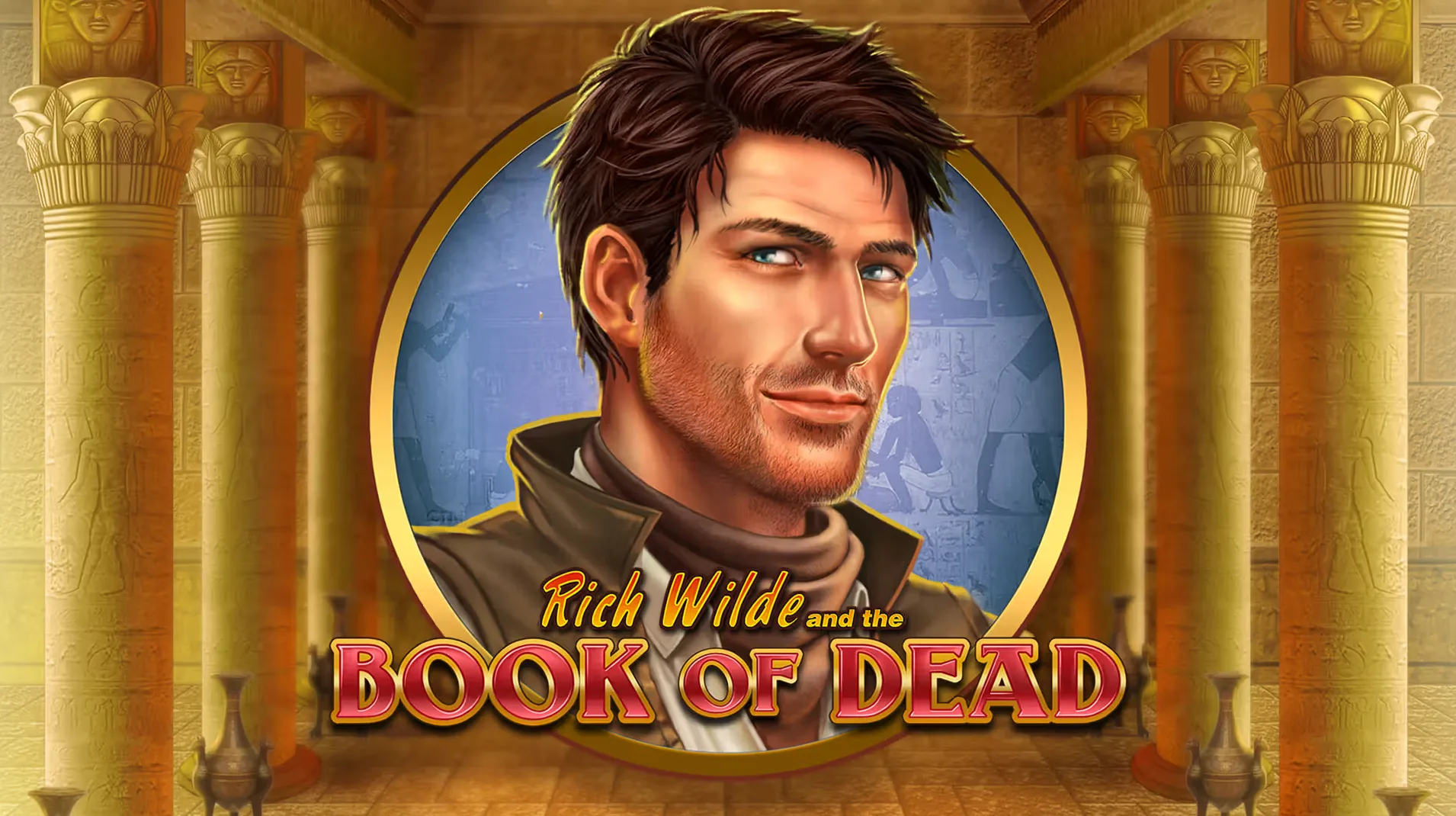 Book of Dead · Play'n GO · 2016
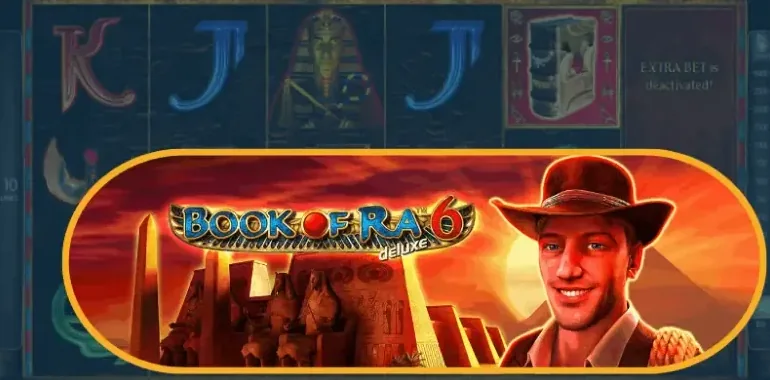 Book of Ra 6 Deluxe · Novomatic
Book of Ra and Book of Dead are frequently compared because the latter is widely understood as the online-first evolution of the former. The two games share a nearly identical basic template — 5×3 grid, 10 paylines, one-symbol-substitutes-for-scatter book mechanic, expanding-symbol free-spins bonus, gamble feature — but differ meaningfully across several specific dimensions. The table below summarises the differences.
| Feature | Book of Ra (Novomatic, 2005) | Book of Dead (Play'n GO, 2016) |
|---|---|---|
| Studio | Novomatic (Austria) | Play'n GO (Sweden) |
| Release year | 2005 (land-based), 2008 (online) | 14 January 2016 |
| Reels / paylines | 5 reels / 9 paylines (original), 10 (Deluxe) | 5 reels / 10 paylines |
| Published RTP | 95.10% (original), 95.03% (Deluxe) | 96.21% |
| Volatility | High | High (7.5/10) |
| Max win | 5,000× line bet (equivalent to ~500× total) | 5,000× total stake |
| Expanding symbol | Yes, one random symbol | Yes, one random symbol |
| Free spins | 10, retriggerable | 10, retriggerable |
| Gamble feature | Yes, card colour | Yes, card colour + suit |
| Mobile-first design | Retrofitted for mobile | HTML5 native from launch |
| UKGC availability | Limited (Novomatic UK footprint smaller) | Ubiquitous across UKGC operators |
| Theme | Egyptian tomb (generic explorer) | Egyptian tomb (Rich Wilde character) |
The key mathematical difference is the RTP: 96.21% (Book of Dead) versus 95.10% (Book of Ra). Over 10,000 spins at £1 stake, that 1.11% difference converts to £111 of expected additional return for Book of Dead. Compounded across a player's lifetime volume, the RTP gap is meaningful. The other significant differentiator is jurisdictional availability — Play'n GO's aggressive multi-market licensing strategy has made Book of Dead available at essentially every regulated online casino globally, while Novomatic's more selective distribution has limited Book of Ra's presence in some key markets (notably the UK, where Novomatic titles are less commonly stocked). For UK players in particular, Book of Dead is the more accessible option; for Central European players with strong Novomatic-brand attachment, Book of Ra remains the sentimental favourite. Neither game is objectively "better" — they occupy the same design space with different studio implementations. Players who prefer Book of Ra's slightly slower pacing and heavier reel-strip weighting on the pharaoh symbol may find Book of Ra a more comfortable experience; players who prefer Book of Dead's modernised UI, higher RTP and character-driven narrative will find Book of Dead the stronger option.
Where Book of Dead Sits Against Category Peers
Book of Dead's position in the book-style category is defined by three qualities. First, distribution: it is one of the most widely available slots in the online casino market and is present at essentially every casino that carries the Play'n GO catalogue, which is most regulated and offshore markets globally. Second, brand recognition: the Rich Wilde character has become a widely recognised intellectual property, giving the game consistent recognition even among casual players. Third, mathematical calibration: the game's high-volatility profile combined with 96.21% RTP places it in a well-established sweet spot for the category — not the extreme volatility of Book of Shadows, not the low-volatility mainstream titles, but a middle-ground profile that suits players who want meaningful upside without the extreme dry stretches of the deepest-volatility titles.
A fourth factor is longevity: Book of Dead is now a decade old and has demonstrated staying power that most 2016-era slots have not. New titles in each release quarter come and go; Book of Dead has remained continuously in the top-30 of most operator catalogues since 2018. This durability is significant because it means the game has been battle-tested at every scale — from £0.10 casual sessions to £100 high-roller spins, from streaming showcases to responsible-gaming case studies. The mathematical model has held up under this scrutiny; no significant balance issues have been documented, no exploits have been discovered, and no material updates to the game's mathematical model have been required. That kind of stability is rare in a category where most titles are refreshed or superseded within 2-3 years.
Best Casinos to Play Book of Dead in the UK
Book of Dead is available at essentially every UKGC-licensed operator that carries the Play'n GO catalogue, which is the vast majority of major UK casinos. The table below highlights ten strong UKGC-licensed operators where Book of Dead is stocked, along with their welcome-bonus structure, wagering multiplier and minimum deposit. All wagering figures apply to the bonus amount unless otherwise noted; all figures reflect standard published offers and are subject to change.
| Casino | Welcome bonus (typical) | Wagering | Min. deposit | Book of Dead |
|---|---|---|---|---|
| Mr Vegas | 100% up to £200 + 11 free spins | 35× | £10 | Play |
| LeoVegas | 100% up to £100 + 50 free spins | 35× | £10 | Play |
| bet365 Casino | 100% up to £100 New Player Bonus | 20× | £10 | Play |
| Betway | 100% up to £250 | 50× | £10 | Play |
| William Hill Casino | 100% up to £300 | 40× | £10 | Play |
| PlayOJO | 50 wager-free spins | 0× (wager-free) | £10 | Play |
| Casumo | 100% up to £25 + 20 free spins | 30× | £10 | Play |
| 21 Casino | 121% up to £300 | 35× | £10 | Play |
| Videoslots | 11 wager-free spins + £10 bonus | 35× (deposit bonus) | £10 | Play |
| Rizk | 100% up to £100 + 50 spins | 35× | £10 | Play |
When choosing a casino for Book of Dead specifically, several factors matter beyond the headline bonus. First, check that the specific installation of Book of Dead runs the 96.21% RTP configuration rather than a reduced variant — this information is available inside the game info screen. Second, confirm that Book of Dead is eligible for the welcome bonus wagering contribution; most UK operators score slots at 100% contribution, but a handful score Book of Dead at 50% or exclude specific book-style slots from bonus play. Third, verify the maximum bet during bonus wagering — the standard cap of £5 per spin applies at most UK operators, but a small number apply lower caps of £2 or £3. Fourth, consider the operator's withdrawal speed and customer support quality — a fast bonus payout matters more than a slightly larger bonus with slow processing. Wager-free options like PlayOJO and Videoslots free spins are worth considering for players who want to keep any winnings without further wagering exposure. All bonuses linked here require registration; players should read full terms on the operator site before committing.
Bonuses and Wagering Requirements for Book of Dead
Understanding how welcome bonuses interact with Book of Dead is essential for calculating the true value of any casino offer. UK operators structure their bonuses around several key parameters: the bonus percentage (typically 100% match on first deposit), the bonus cap (£100-£500 at most operators), the wagering multiplier (typically 20-50×), the game-contribution ratio (typically 100% for slots), the maximum bet during wagering (typically £5), and the maximum cashout cap (typically 5-10× the deposit or bonus amount).
A typical bonus example: deposit £100 at a casino offering "100% up to £100 with 35× wagering." Player receives £100 bonus, bringing the balance to £200. To convert the bonus to withdrawable cash, £100 × 35 = £3,500 must be wagered on eligible slots. If Book of Dead contributes 100% to wagering, this translates to spinning £3,500 total volume on Book of Dead. At £1 per spin that is 3,500 spins; at £2 per spin (subject to the £5 max-bet cap), 1,750 spins. The expected loss over £3,500 wagered at 96.21% RTP is approximately £133 — so the theoretical net gain from clearing the bonus is £100 - £133 = -£33 in expected value, before considering variance. This means most welcome bonuses are effectively risk-mitigation offers rather than positive expected-value opportunities in the strict mathematical sense.
The wagering multiplier applied matters enormously. A 20× wagering bonus (bet365) requires £2,000 wagered on the same £100 bonus, versus £5,000 wagered on a 50× wagering bonus (Betway). At Book of Dead's 96.21% RTP the expected loss on £2,000 wagered is ~£76 (giving a positive £24 expected value); on £5,000 wagered the expected loss is ~£190 (giving -£90 expected value). This is why players evaluating welcome bonuses should focus on the wagering multiplier as much as the headline percentage.
Common excluded games at UK operators include table games (blackjack, roulette, baccarat all typically score 5-10% contribution, sometimes 0%), live-dealer games (usually 0% contribution), and specific high-RTP or high-volatility slots that operators consider "abuse risk" — Blood Suckers, Book of 99, Mega Joker and 1429 Uncharted Seas are commonly excluded. Book of Dead is universally eligible at 100% at UKGC operators, which makes it a convenient choice for bonus wagering. Max-bet caps of £5 per spin are enforced automatically at most operators — any spin above the cap while a bonus is active typically results in bonus voiding with all bonus-derived winnings forfeited. Cashout caps of 5-10× deposit or bonus are common and effectively cap the upside of clearing a bonus: even if a player hits Book of Dead's max win during bonus play, the payout is capped at the operator's cashout limit. Read the specific bonus terms before playing.
Demo and Free-Play Availability
Book of Dead is widely available in demo mode across regulated and non-regulated casino sites. The demo version uses identical mathematical parameters to the real-money version — RTP, volatility, symbol distribution and bonus mechanics are unchanged. The demo starts the player with a fixed virtual bankroll that resets when the browser tab is closed. Demo play is a useful way to learn the game mechanics and to feel the volatility profile before committing real money, and Play'n GO's demo distribution is consistent enough that the demo experience matches the real-money experience closely. Some jurisdictions restrict demo access to registered users; in those markets the demo requires an account creation but not a deposit.
The demo hosted at the top of this page is provided by Play'n GO's official demo distribution CDN and runs the standard 96.21% RTP configuration. Note that under UKGC rules introduced in 2021, most UK-facing operators cannot show demo mode to unregistered visitors, so if you visit an operator site from a UK IP you will typically need to register (though not necessarily deposit) before demo access is enabled. This is a UKGC regulation designed to prevent underage exposure to slot content; it is not a Play'n GO restriction. Non-UKGC-licensed operators typically make the demo freely available. Demo mode is functionally useful for a few purposes: learning the paytable and bet interface before committing real money; feeling out the free-spins trigger pattern and expanding-symbol variance; and stress-testing the RTP configuration at a specific operator (some players spin 500-1000 demo spins to check that the RTP behaves as published, though variance means small samples are unreliable indicators).
Responsible Play and Session Management
Book of Dead's high-volatility profile makes responsible-play discipline particularly important. Session-length limits, deposit limits and win/loss targets are all standard tools available at licensed casinos and all apply to Book of Dead play. Players should establish a session bankroll aligned with the game's volatility (see the 400× rule-of-thumb earlier in this review) and stop when that bankroll is exhausted rather than depositing again mid-session. Autoplay stop-on-loss triggers are useful for enforcing this discipline. Chasing losses on high-volatility slots is mathematically counterproductive — the RTP is set at 96.21% and cannot be beaten by any pattern of play, so the only sustainable approach is fixed-budget entertainment play with the expectation that the long-term outcome is a 3.79% loss on the total amount wagered, distributed unevenly across sessions. Support resources including GamCare, BeGambleAware and GAMSTOP self-exclusion are available in the UK and are signposted at every UKGC-licensed operator's site.
Specific UK responsible-gaming tools that apply to Book of Dead include: deposit limits (daily, weekly, monthly — can be reduced immediately, increases subject to 24-hour cooling-off period), loss limits (same structure), session time limits with automatic logout, reality checks (default 60-minute intervals for slots), self-exclusion for periods of 6 months, 1 year, 2 years or 5 years, and the industry-wide GAMSTOP self-exclusion register that blocks access to all UKGC-licensed operators simultaneously. These tools are mandatory at UKGC operators and their enforcement is audited. GamCare provides free confidential support at 0808 8020 133 and via live chat at gamcare.org.uk; BeGambleAware runs the National Gambling Helpline at 0808 8020 133 and offers online counselling. Book of Dead's design is compliant with the UKGC's 2021 slot-design rules (no autoplay above 2.5-second minimum spin duration, no celebratory sound effects on losses-disguised-as-wins, no reverse-withdrawal features).
Book of Dead Tips: What Works and What Doesn't
There is a substantial body of folk-wisdom around Book of Dead strategies, much of it derived from streaming culture and community forums rather than mathematics. The genuinely useful tips are grounded in bankroll management and self-discipline rather than in beating the game — because the RTP is fixed and no pattern of play can improve it, "strategy" in the traditional sense does not exist. What follows is a set of practical, evidence-based tips.
Manage bankroll conservatively. A widely used rule is to spin at 0.5% of the session bankroll per spin — so a £200 session budget suggests £1 per spin, a £500 budget suggests £2.50 per spin. This ratio provides enough spin count (400+ spins) to statistically encounter at least one bonus round in most sessions while keeping variance within manageable bounds. Below 0.25% per spin the session becomes tediously slow; above 1% per spin the risk of bankroll exhaustion before a bonus becomes significant.
Set stop-loss and stop-win triggers. Use the operator's autoplay stop-on-loss trigger set to your full session budget. Set stop-on-single-win to a level that would end the session on a positive note — 50× stake is a common choice that maintains upside while triggering an exit on any meaningful hit. Do not manually override the triggers mid-session.
Session length: 60-90 minutes for high-vol. Cognitive research on gambling suggests that decision-making quality declines significantly after 60-90 minutes of continuous slot play. UKGC reality-check triggers at 60 minutes are calibrated for this reason. Book time-limited sessions rather than open-ended ones.
Disable auto-play on max-win chases. If a session shows an unusually large early win, disable autoplay and manually decide whether to continue. Autoplay is optimised for extending sessions, not for preserving wins.
Avoid the gamble feature on big wins. The gamble feature has neutral expected value in most configurations but adds variance that can wipe base wins entirely. On any win above 20× stake, take the win and skip the gamble.
Verify the RTP configuration. Before playing at any operator, open the game-info screen and confirm the RTP is 96.21%. If it shows 94.20% or 92.24%, seek a different operator — the RTP difference over meaningful volume is substantial.
Take breaks. UKGC-mandated reality checks appear every 60 minutes at UK operators; treat them as an opportunity to genuinely stop, not as a dismiss-and-continue prompt. A 15-minute break every hour is a documented aid to bankroll discipline.
What does not work. Betting patterns (Martingale, Fibonacci, D'Alembert etc.) do not affect long-run RTP — they change the variance profile but do not create positive expected value. "Following streaks" is a form of gambler's fallacy — each spin is independent and past outcomes do not affect future ones. Switching casinos to "reset variance" does not work — the game engine is centralised and outcomes are identically distributed across all installations of the same RTP variant. There is no "trick" to force the bonus round; the trigger is a pure random-number outcome per spin.
Session Strategy and Realistic Expectations
Practical session strategy for Book of Dead follows from the mathematics rather than from folklore. Reduce the coin value to a level where the intended session bankroll covers at least 300-400 spins at the chosen bet, choose a fixed number of paylines (10 is the standard recommendation for a normal experience), enable autoplay with a stop-on-loss trigger set to your session budget and a stop-on-single-win trigger set to a level that would end the session on a positive note. Do not increase the stake after a losing stretch — the game has no memory of prior spins and the RTP does not shift toward the player after a dry run. Do not use the gamble feature as a bankroll-building strategy — its long-run expected value is neutral at best, and the variance it adds can wipe base-game wins that would otherwise have contributed positively to session outcome. Treat session-time limits and reality checks as part of the session plan, not as obstacles.
Realistic expectations for a typical session look like this. Over 400 spins at £1 per spin (£400 total wagered), the expected return is £385 (96.21% × £400), for an expected loss of £15. Standard deviation of session outcome is approximately £48, so a one-sigma band ranges from £337 to £433 — meaning most sessions end in that range. The tails matter: roughly 5% of sessions end below £250 (a £150+ loss), and roughly 5% end above £520 (a £120+ profit). Any single-session win of £1,000 or more is statistically rare (below 0.5% probability). The 5,000× maximum-win outcome is functionally invisible at the session-frequency level — it will occur approximately once every 2.67 million spins across all players globally, or roughly a handful of times per year across the entire Book of Dead player base. Setting expectations around these numbers rather than around folklore about "hot" and "cold" sessions is the mark of a mathematically-informed player.
Where Book of Dead Fits Into a Balanced Slot Portfolio
For a player who plays multiple slot titles across a monthly play budget, Book of Dead fits into the high-volatility, book-style bonus-focused segment of the portfolio. A balanced monthly slot rotation might include a low-volatility mainstream title (Starburst, Sweet Bonanza) for extended entertainment play, a medium-volatility Megaways or cluster-pays title for the middle band, and a high-volatility book-style slot such as Book of Dead for the concentrated-bonus-focused sessions. Book of Dead's advantages within its category are its consistent distribution across operator catalogues (making it easy to play at any licensed casino), its widely recognised brand and its well-calibrated mathematical model that produces meaningful upside without the extreme dry stretches of the deepest-volatility alternatives. Its disadvantage is that its 96.21% RTP is slightly below the modern category median, meaning long-term expected loss is marginally higher than at a same-volatility 96.5%-96.7% alternative.
Within a monthly budget of £100-£200, a reasonable allocation is £30-50 to Book of Dead sessions across 2-4 sessions per month, £30-50 to a low-volatility slot for extended play, and £30-50 to a middle-band exploration slot. This diversification serves both entertainment and variance-management purposes: high-volatility play at 100% of the budget concentrates outcome variance into a small number of sessions, most of which will be losing sessions punctuated by rare wins; diversifying across volatility bands produces a more consistent session-outcome distribution while still allowing for the upside of high-volatility play on Book of Dead sessions. Players with monthly budgets above £500 can extend this framework to include additional high-volatility titles (Legacy of Dead, Fire in the Hole, Money Train series) rather than concentrating all high-vol allocation on Book of Dead. The critical framework is to treat slot play as an entertainment budget, not as an income-generation activity — the 3.79% house edge on Book of Dead means the long-run expected outcome is a monthly cost, not a monthly return.